I have received multiple complaints that Town Councilor Shawn Faber is blocking residents and and hiding comments on his Shawn Faber for Londonderry Town Council Page.
There have been a number of Supreme Court cases that have upheld that Public Officials cannot censor comments on their Social media accounts. The ACLU Statement on Supreme Court’s Decision Related to Whether Public Officials Can Block Social Media Followers March 15, 2024
WASHINGTON – The Supreme Court on Friday clarified when public officials’ social media posts are subject to the First Amendment in response to two challenges, O’Connor-Ratcliff v. Garnier and Lindke v. Freed.
“We’re gratified by the court’s ruling today, which underscores that the First Amendment restricts how the government can shape speech that takes place on social media,” said Evelyn Danforth-Scott, ACLU staff attorney specializing in Supreme Court litigation. “It gives everyday Americans a way to hold officials constitutionally accountable when they censor social media content, restrict access to it, or improperly elevate certain viewpoints over others. At the same time, it protects public officeholders’ own free speech rights by giving them guidance on how to make clear when they are speaking as private individuals.”
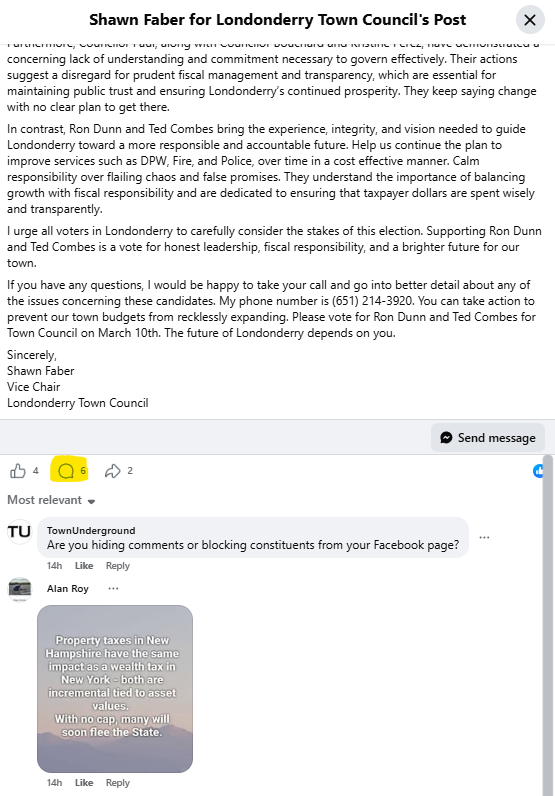
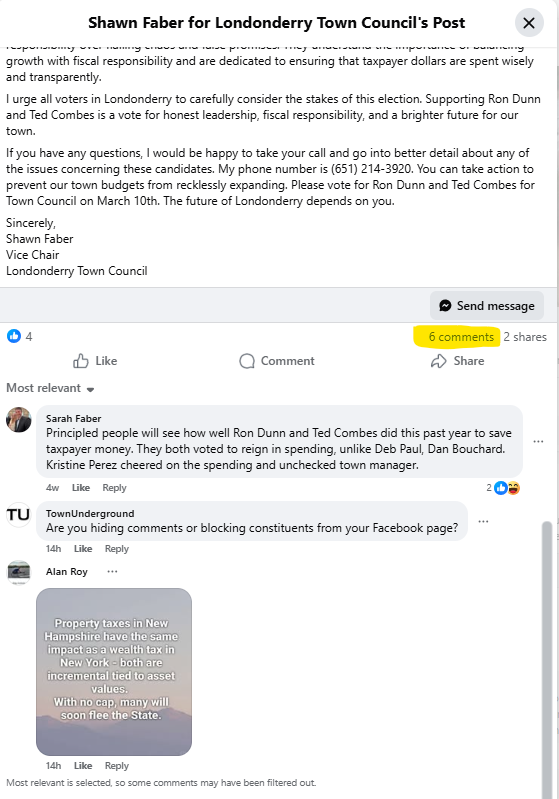
There are a number of posts on the Faber’s page that show a comments total but the comments visible are less than the totals. This indicates that comments have been hidden.
I have confirmed that several comments I have posted are not visible to others. Councilor Faber has been asked if he is blocking constituents or hiding comments but has not responded.
The post below has 6 comments but only 2 are visible
The same post viewed by a different Facebook account has 6 comments but only 3 visible comments
From ChatGPT
🔒 What “hiding” a comment means
- The comment is still visible to:
- The person who posted it
- That person’s friends
- But it’s invisible to everyone else on the page
So to the commenter, it looks like nothing happened.
⚙️ Who can hide comments?
On a Facebook page (like a public official’s page), the following can do it:
- Page admins
- Editors/moderators
⚖️ Important (especially for public officials)
If the page belongs to a public official using it for official business, hiding comments can raise First Amendment concerns.
Courts have ruled (in cases like Knight First Amendment Institute v. Trump) that:
- Public officials can’t selectively suppress viewpoints in official public forums
- Hiding or deleting comments based on viewpoint may be unconstitutional
However:
- They can moderate for things like spam, threats, or profanity (if applied consistently)
Yes — public officials can technically block or hide comments, but whether they’re allowed to (legally) depends on how the account is being used.
⚖️ Key distinction: Public office vs. personal account
1. Official government pages/accounts
If a public official uses a social media page as an extension of their office (e.g., posting official updates, engaging with constituents), courts have increasingly treated that page as a public forum.
- Under the First Amendment to the United States Constitution, viewpoint discrimination is generally prohibited.
- That means:
- ❌ Blocking someone because of their viewpoint is usually not allowed
- ❌ Hiding or deleting comments because they criticize the official is also often not allowed
A major case:
- Knight First Amendment Institute v. Trump
Found that blocking critics from an official Twitter account used for government communication violated the First Amendment.
Another key development:
- Lindke v. Freed
The Supreme Court clarified that officials can be subject to First Amendment limits if their social media activity counts as “state action” — meaning they’re acting in their official capacity.
👉 Bottom line: If the page is functioning like a digital town hall, viewpoint-based blocking or hiding comments can violate free speech rights.
2. Personal or campaign pages
If the account is clearly:
- Personal (family posts, private life), or
- Campaign-related (election-focused)
Then the official has much more freedom to:
- Block users
- Delete or hide comments
Because those spaces are generally not considered government-controlled forums.
⚠️ What is usually allowed (even on official pages)
Officials can still enforce content-neutral rules, such as removing:
- Spam
- Threats or harassment
- Obscenity
- Off-topic comments (if rules are clearly stated and applied evenly)
🧭 Practical takeaway
- Criticism alone ≠ valid reason to block/hide comments on an official page
- Consistency matters — selective enforcement can create legal issues
- The line between “official” and “personal” pages is often where disputes happen
Related Posts:
Candidate for State Senator Censoring Social Media
Public Officials Cannot Block Critics on Social Media
State Representative blocking constituents from Facebook page
Liberate Leach Library – Blocks Accounts and Issues Warning to those that ‘Do not Support the Library’